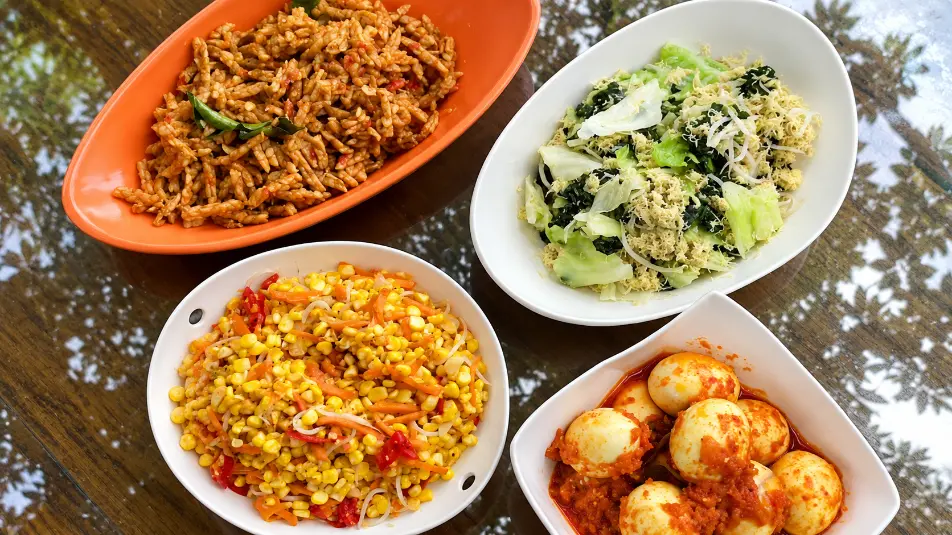
Balinese nasi campur is more than rice served with several side dishes. It brings different textures, spices, and cooking traditions together on one plate, which is why it can be such a useful introduction to Balinese food. If you are wondering what makes it distinctly Balinese, the answer is not one fixed recipe. It is the way rice, seasoned proteins, vegetables, sambal, and local spice traditions come together in balance. That same idea of many elements moving as one is also what makes nasi campur feel naturally at home after a Jari Menari massage.
The name is straightforward. Nasi means rice and campur means mixed. In practice, Balinese nasi campur usually places rice at the center of a meal with several smaller accompaniments around it.
That sounds simple, but the experience can be surprisingly layered. One bite may be aromatic and savory. Another may be fresh, spicy, or slightly sweet. Vegetables add texture while sambal adds brightness and heat. The rice connects everything without competing with the stronger flavors around it.
This is also why two plates of nasi campur in Bali may look quite different. One warung may serve shredded chicken, sate lilit, vegetables, and sambal matah. Another may include lawar, betutu, egg, or a different local preparation. The format stays recognizable even when the individual components change.
If you have been searching for the original Balinese nasi campur recipe, there is an important detail to know. There is no single standardized version that defines every authentic plate, and there is no widely documented single inventor or exact birth date for the dish.
It is more useful to think of nasi campur as a way of eating and serving food. Rice becomes the base for several dishes that reflect the cooking style of a household, warung, community, or region.
That flexibility is part of its character. Authenticity does not depend on every plate having exactly the same number of side dishes. What matters more is whether the flavors and preparations have a meaningful connection to Balinese cooking.
One reason Balinese nasi campur tastes different from mixed rice dishes elsewhere in Indonesia is the local spice tradition behind many of its components.
Base genep is one important part of that story. It is a traditional Balinese spice mixture that can include aromatic roots and spices such as galangal, ginger, turmeric, and kencur. Its significance goes beyond everyday cooking because Balinese food traditions are also connected with community and ritual life.
You do not need to identify every spice while eating nasi campur to appreciate it. What you are likely to notice is depth. A piece of chicken may carry warm aromatic notes. A vegetable preparation may be lighter and fresher. Sambal may cut through richer elements. The plate works because those flavors do not all try to do the same thing.
There is no special rule saying you should eat nasi campur after a massage, and the dish should not be presented as having a medical benefit simply because it follows a wellness treatment.
The connection is more practical and sensory.
After a long massage, you may want to stay in the relaxed rhythm of the experience rather than move immediately into a large or complicated meal. A thoughtfully portioned nasi campur can provide variety without requiring one heavy main dish. You can move between rice, vegetables, protein, and sambal at your own pace.
It also gives you some control over intensity. If you prefer less heat, you can use less sambal. If you want something lighter, you can focus more on the rice and vegetables. If you want a fuller taste of Balinese cooking, you can combine several elements in one bite.
That flexibility matters when food is part of a longer wellness experience rather than a separate restaurant visit.
Guests receive a 90 minute massage followed by lunch. Nasi Campur is one of the current lunch choices and is described with chicken curry, yellow rice, and vegetables.
The menu itself is intentionally simple, but the cultural idea behind nasi campur gives the meal more context. It is not only a convenient plate after treatment. It can also become a gentle continuation of the same sense of rhythm and balance that shapes the massage.
During a Jari Menari massage, a guest may experience long strokes, rocking, stretching, and consistent pressure. The value is not in treating each movement as a separate event. The movements are connected so the session feels continuous.
Balinese nasi campur has a similar sensory logic.
Rice, vegetables, spice, protein, and sambal keep their own character, yet they are eaten as one meal. You notice contrast, but you also notice how the parts support one another.
That gives us a simple way to describe the relationship between the two experiences. Many movements can become one flow, and many flavors can become one plate.
This is a modern interpretation of how the experiences complement each other. It is not a claim that nasi campur historically developed from massage philosophy. Keeping that distinction clear matters because Bali's culinary traditions have their own history and cultural context.
People sometimes assume that food served in a wellness setting needs to become so mild or simplified that it loses its local character. It does not have to.
A thoughtful approach is to keep the flavor language Balinese while adjusting portion size and intensity for the setting. The spice can remain aromatic without making every component very hot. Vegetables can play a larger role. Sambal can be served in a way that lets each guest decide how much heat they want.
This is especially relevant for international visitors. You may be curious about Balinese food but unsure about spice levels, unfamiliar ingredients, or whether a dish will feel too heavy after a treatment. Nasi campur gives the kitchen room to create a balanced introduction without pretending that every guest has the same preferences.
For Jari Menari, that makes the format more useful than a generic lunch plate. It can connect a wellness experience with a sense of place.
No. Some versions in Bali do include pork, especially plates built around babi guling, but pork is not a requirement of nasi campur.
Chicken based nasi campur is common, and other versions may use fish, egg, or vegetable preparations. If you have dietary or religious requirements, it is always worth checking the specific menu because the words nasi campur describe the format of the meal rather than one fixed ingredient list.
At Jari Menari, the current Gourmet Massage menu describes its Nasi Campur with chicken curry, yellow rice, and vegetables.
Not necessarily. Balinese cooking is known for aromatic spices and can include plenty of chili, but the level of heat varies by recipe.
Sambal is often the hottest element on the plate. When it is served separately or in a modest portion, you have more control over how spicy the meal becomes.
No, and that is part of the point.
A family kitchen, local warung, hotel, and wellness venue may each create a different version. Rather than looking for one universal recipe, pay attention to the balance of the plate, the use of Balinese seasoning, the quality of each component, and how the meal fits its setting.
A good Bali experience often comes from small details that feel connected. A massage can slow your pace. A garden can extend that sense of calm. A meal can help you stay present a little longer instead of rushing straight back into the day.
Balinese nasi campur fits that transition because it is built around variety held together by balance. It gives you several tastes of Bali in a single meal while leaving room for the kitchen to adapt the plate to its setting.
At Jari Menari, that idea feels especially natural. The massage brings different movements into one flowing experience. Nasi campur brings different flavors into one plate. Neither needs every element to be identical. What matters is how the parts work together.
If you would like your time at Jari Menari to continue beyond the treatment room, see the Gourmet Massage experience at Jari Menari, where a 90 minute massage is followed by lunch and Nasi Campur is one of the current menu choices.
Our fabulous Massage Gift Certificate are now available for purchase
online. For your friends, family and colleagues.